1
Community Petition
CompletedResidents organized and submitted a petition supporting the incorporation of Bethlehem, collecting more than 1,200 signatures.
PROPOSED TOWN OF BETHLEHEM
Residents of Bethlehem are pursuing incorporation to establish local government and give our community a greater voice in how Bethlehem grows, develops and plans for the future.
Explore the incorporation processWHY INCORPORATE
In May 2024, Alexander County adopted countywide zoning changes that shifted toward a density-based approach to development. Soon after those changes were adopted, three major residential developments totaling 721 homes were approved along an approximately 1.5-mile stretch of Rink Dam Road. Since then, three additional developments have also been approved.
These decisions have raised concerns among Bethlehem residents about increasing traffic, the ability of roads and other infrastructure to keep pace with growth, and the potential loss of the small-town character that makes our community special.
Bethlehem is growing, and residents understand that growth will continue. The question is how that growth is planned and managed—and whether local residents have a meaningful voice in the decisions that shape their community.
Incorporation would give Bethlehem its own local government, with elected leaders focused on our community’s needs, priorities, and future. It would provide a local framework for planning and zoning, addressing infrastructure concerns, and guiding future growth in a way that respects Bethlehem’s character. It would not eliminate the county’s responsibilities or guarantee that every development could be prevented, but it would give Bethlehem residents a more direct voice in decisions affecting their community.
The goal is straightforward: to help Bethlehem grow responsibly, protect what residents value about their community, and ensure that local priorities receive focused attention as the area continues to develop.
THE PATH TO INCORPORATION
From the community petition through legislative consideration, each stage moves the proposal forward.
Residents organized and submitted a petition supporting the incorporation of Bethlehem, collecting more than 1,200 signatures.
The Alexander County Board of Elections verified 1,076 qualified signatures out of 1,250 submitted, exceeding the required 995 signatures.
Bethlehem prepared its proposed tax and financial plan for review by the North Carolina Local Government Commission (LGC). In its final statement, the LGC found Bethlehem likely to be financially viable based on projected property-tax and sales-tax revenues.
Read about the financial review →Bethlehem’s incorporation packet has been submitted to the North Carolina General Assembly’s Municipal Incorporations Subcommittee for review and consideration.
The proposed incorporation legislation must proceed through the North Carolina General Assembly. The proposal is not final until the required legislative action is complete.
Depending on the final legislation and applicable legal requirements, residents may be asked to vote on incorporation.
WHY INCORPORATE
A municipal government would give Bethlehem elected local officials responsibility for municipal decisions affecting the community.
Planning and zoning would be handled within a local municipal framework rather than solely through county-level processes.
The proposed Town identifies planning and zoning, police, fire and rescue, and street lighting among its initial municipal services.
Local elected officials would be accountable directly to Bethlehem voters for the decisions and services of the Town.
THE PROPOSAL
Incorporation would create a new municipal government within the proposed Bethlehem boundaries. The final charter and governing structure remain subject to legislative action.
Read the proposal →County framework and countywide elected government
Local municipal framework and elected local officials
GROWTH
Several high-density residential projects have been identified within the proposed community. Development information will be updated as new information becomes available and as development plans, project details, or approval status change.
WHY INCORPORATE
Bethlehem is a growing community with local needs and priorities that deserve focused attention. Alexander County provides important services and has responsibilities to serve the entire county. County leaders must balance competing needs, priorities, and available resources across all the communities they serve. Incorporation would give Bethlehem its own local government, with elected officials directly accountable to Bethlehem residents and focused on the community’s priorities.
A local government could provide a more direct voice in planning and zoning, public safety, street lighting, and decisions about future growth. It could also create opportunities to pursue grants and other funding specifically available to municipalities, potentially bringing additional resources to Bethlehem for eligible projects and services. Incorporation would not eliminate the county’s role or guarantee grant funding; it would establish another level of local representation and a framework for addressing Bethlehem’s needs while planning responsibly for its future.
Incorporation would create a local governing body elected by Bethlehem residents. Decisions about municipal priorities would be made by officials accountable to the people who live within the proposed town boundaries.
Road conditions, traffic safety, congestion, and needed improvements have been identified as concerns for the Bethlehem community. A town government could help bring these priorities directly to the North Carolina Department of Transportation (NCDOT), coordinate with NCDOT staff, advocate for projects, and pursue available transportation funding. NCDOT would retain authority over state-maintained roads, and incorporation would not guarantee funding or faster improvements, but Bethlehem would have a local government focused on communicating the community’s transportation needs.
The proposed community is experiencing growth and development. A municipal government would provide a local framework for planning and zoning, helping Bethlehem address land-use decisions and future growth within the proposed town.
Municipal status could make Bethlehem eligible to apply for certain grants and funding programs that are available to local governments. Eligibility depends on the requirements of each program, and funding is not guaranteed.
The incorporation materials identify planning and zoning, police protection, fire and rescue, and street lighting as proposed initial municipal services. The proposed service plan and financial materials describe how the community intends to plan for those responsibilities. Final services, governance, and financial provisions remain subject to the incorporation process and legislative action.
Incorporation is not a statement that Alexander County is failing to serve its residents. County government must make decisions for communities across the county and balance needs and resources countywide. A Town of Bethlehem would provide an additional local level of representation focused on the priorities of residents within its boundaries, while recognizing the county’s continuing role.
THE PROPOSAL
The incorporation proposal includes a proposed boundary, municipal services, governance provisions and a draft charter for legislative review.
The proposed boundaries were drawn to include the Bethlehem Fire District and Bethlehem voting districts 1 and 2. Using these existing service and voting areas as a guide is intended to support coordination of fire and emergency services, make voter administration more straightforward, and help simplify local tax administration.
PROPOSED TOWN BOUNDARY
The petition materials show the proposed boundary in two views. Select either map to open a larger version.
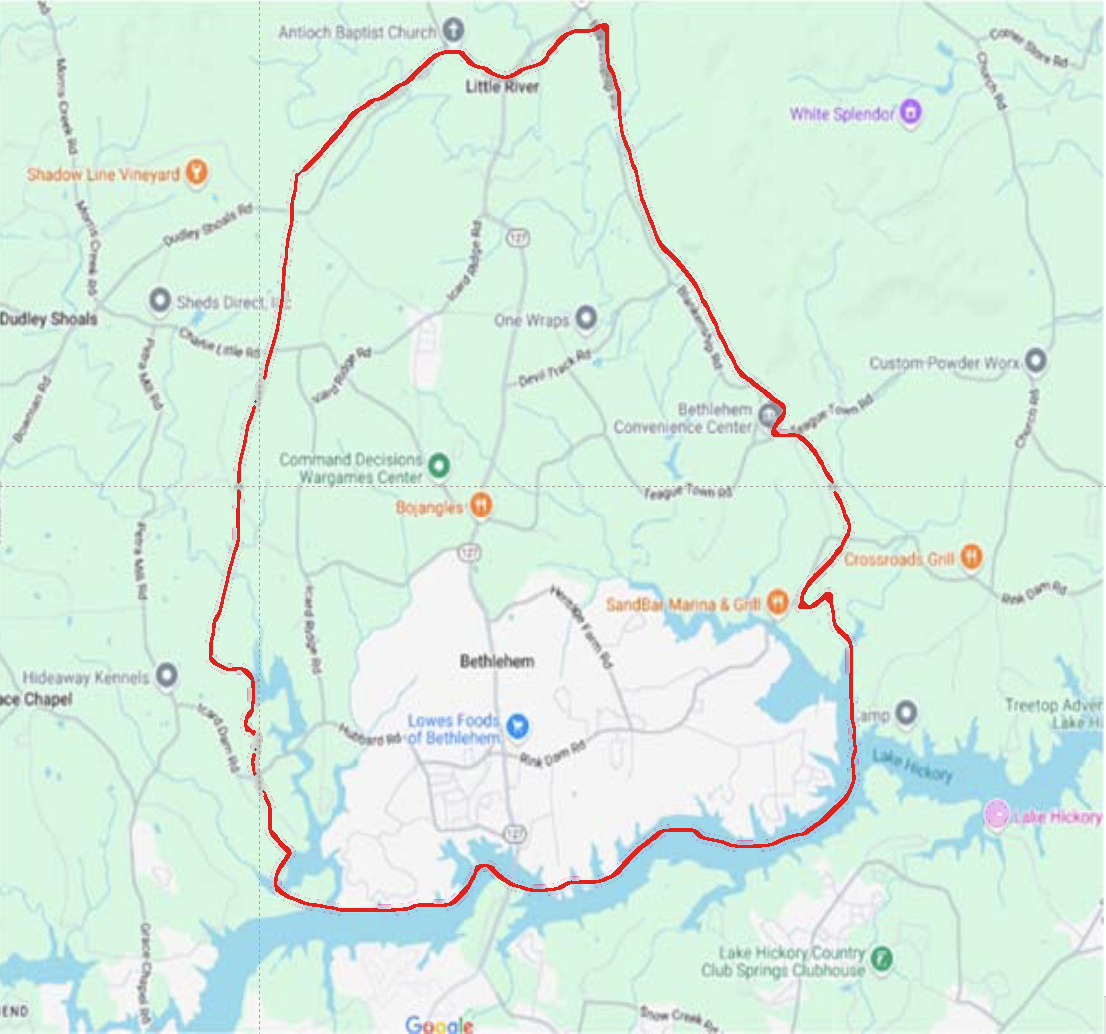
The red outline is approximate and is provided only as a general visual guide. For accurate boundaries, refer to the written boundary description in the proposed incorporation bill and the official GIS boundary map.
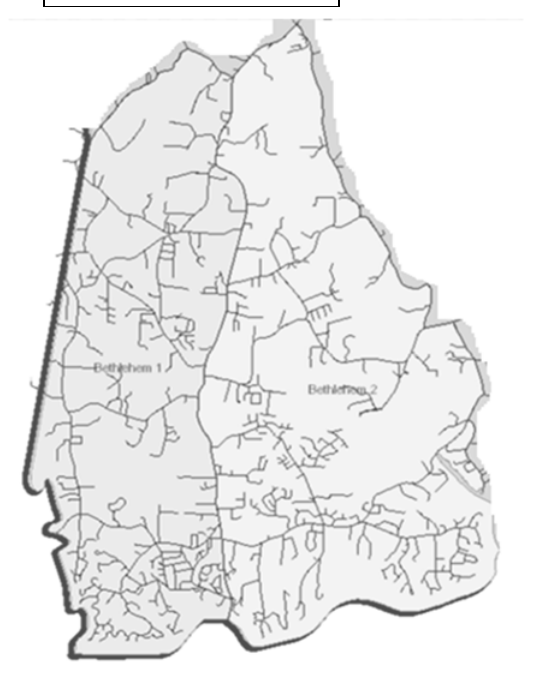
Road network and boundary detail from the petition map.
Important: The red outline on the Google Maps image is approximate and is not an official survey or legal boundary. For accurate boundaries, use the written boundary description in the proposed incorporation bill and consult the official GIS boundary map.
The following is the written boundary description from the current proposed incorporation bill, Article II, Section 2.1:
Beginning at the intersection of Antioch Church Road, SR 1002, and the common boundary line between Caldwell County and Alexander County, thence in a generally Eastern direction with Antioch Church Road, SR 1002, to its intersection with NC Highway 127, thence in a Northerly direction with NC Highway 127 to its intersection with Blankenship Road, SR 1152, thence in a general Southeastern direction with Blankenship Road, SR 1152, to its intersection with Teague Town Road, SR 1150, thence in a generally Easterly direction with Teague Town Road, SR 1150, to its intersection with Bowman's Cutover Road, SR 1151, thence in a generally Southern direction with Bowman's Cutover Road, SR 1151, to its intersection with Rink Dam Road, SR 1137, thence with Rink Dam Road, SR 1137, in a generally Southern direction to its intersection with B & T Lane, SR 1191, to its intersection with Emerald Point Drive, thence with Emerald Point Drive to the shoreline in a Western direction to Rink Dam Bridge to the intersection of the center of Middle Little River, thence in a Southerly direction with Middle Little River to its intersection with the Catawba River/Lake Hickory, thence with Catawba River/Lake Hickory in a Westerly direction to the common boundary line between Alexander and Caldwell County, thence with the common boundary line between Alexander and Caldwell County to the intersection of Antioch Church Road, SR 1002, the point and place of beginning.
This is the description in the current proposed bill, which remains a draft for legislative review. Refer to the final enacted legal description if the bill is amended.
PROPOSED SERVICES
Establish local planning and zoning authority so Bethlehem residents have a stronger voice in how their community develops. Local oversight would allow town leaders to focus on Bethlehem’s priorities, guide future growth, consider the impact of new developments on roads and infrastructure, and work to preserve the community’s small-town character.
Work with the Alexander County Sheriff’s Office to provide an increased law-enforcement presence in Bethlehem as the community grows. The goal is to improve public safety, strengthen the local response to community concerns, and coordinate with the Sheriff’s Office on appropriate coverage and service needs.
Assume responsibility for the existing contract for fire protection provided by the Bethlehem Fire Department and work in partnership with the department to support its needs as the community grows. The town’s goal would be to help sustain reliable fire and emergency services, support the department’s long-term needs, and ensure that fire protection keeps pace with future development.
Identify areas where street lighting could improve visibility and safety, and add lighting as appropriate as Bethlehem continues to grow. Priorities could include locations where residents, pedestrians, and motorists would benefit from better nighttime visibility, helping create safer roads and neighborhoods as the community expands.
The petition materials also identify solid-waste collection and disposal as a potential additional service.
The proposed Town is in Alexander County. The petition boundary generally follows roads, waterways and the Alexander/Caldwell County line, including portions along Lake Hickory and the Middle Little River.
The official boundary map and legal description should be used for exact boundary questions.
View official materialsThe current proposed incorporation bill and charter are drafts supplied for legislative review. The final language will depend on legislative action.
FINANCES
The proposed Town of Bethlehem’s financial plan is designed to fund local services, support responsible financial management, and minimize the tax impact on residents. The figures below are planning estimates, not final appropriations.
The proposed budget anticipates approximately $3.03 million in annual revenue and planned expenditures. Final amounts would depend on actual revenues, service arrangements, staffing decisions, and budgets adopted if incorporation is approved.
| Revenue source | Estimated annual amount |
|---|---|
| Municipal property tax | $522,500 |
| State-shared and other distributions | $2,015,000 |
| Beer and wine tax | $26,250 |
| Solid waste/disposal tax | $4,500 |
| Natural gas tax | $6,750 |
| Electricity tax | $337,500 |
| Telecommunications tax | $60,000 |
| Video programming tax | $60,000 |
| Total projected revenue | $3,032,500 |
The proposed municipal property-tax rate is 5 cents per $100 of assessed property value. Earlier incorporation materials used an approximate $550,000 property-tax estimate; the detailed budget uses $522,500. That is 95% of the earlier estimate, reflecting a 95% collection assumption (a 5% allowance for taxes not collected). For comparison, Alexander County’s audited current-levy collection rate for fiscal year 2024–2025 was 97.36%. The Town’s final estimate would depend on its own tax base and collection assumptions.
| Proposed expenditure | Estimated annual amount |
|---|---|
| Administration—salaries and related expenses (Town Manager/Clerk, Finance Director) | $350,000 |
| Professional services | $200,000 |
| Office expenses | $20,000 |
| Furnishings and equipment | $10,000 |
| Parks and recreation | $100,000 |
| Snow and ice removal | $10,000 |
| Tax collection | $50,000 |
| Election services | $50,000 |
| Other operating expenses | $15,000 |
| Planning and zoning | $140,000 |
| Police protection | $400,000 |
| Fire and EMS | $600,000 |
| Street lighting | $120,000 |
| Insurance | $80,000 |
| Contingency | $151,625 |
| Capital reserve | $735,875 |
| Total planned expenditures | $3,032,500 |
No commissioner salaries are included in the proposed budget. The interim commissioners and future Town Council members are expected to serve on a volunteer basis.
The $350,000 administration salaries and related expenses line is intended to fund staffing and employment-related costs needed to operate the town—not compensation for commissioners. The proposed staffing plan identifies positions such as Town Manager, Town Clerk, and Finance Officer. Final staffing and compensation would be determined through the town’s budget and hiring process.
The financial plan proposes a 5-cent municipal property tax to fund Bethlehem’s local government and services. The plan also anticipates a corresponding 5-cent reduction in the existing fire tax, with the goal of offsetting the new municipal tax.
Under this approach, residents would pay the proposed municipal tax while the existing fire tax would be reduced by the same amount. The intended result is no net increase in the combined property-tax rate from these two changes.
The proposed budget includes $600,000 annually for Fire and EMS. That funding is intended to support fire and emergency services as the town assumes its planned responsibilities. The offset depends on final arrangements with the county and fire district and on budgets and tax rates ultimately adopted. The plan’s goal is a 5-cent reduction in the existing fire tax; the final tax impact will depend on those arrangements.
The proposed budget includes funding for administration, professional services, tax collection, elections, operating expenses, contingency, and capital reserves. These allocations are intended to support day-to-day operations while providing funds for unexpected expenses and future needs.
The North Carolina Local Government Commission’s December 2, 2025, statement indicated that the proposed Town appeared financially viable based on projected property-tax and sales-and-use-tax revenues. The LGC also stated that it could not determine whether the Town could carry out appropriate fiscal-management practices because of a statewide shortage of qualified finance staff. The statement was not a recommendation for or against incorporation.
If incorporation is approved, the Town would need sound financial procedures, accurate records, annual budgets, and appropriate public oversight of revenues and expenditures.
The draft incorporation bill proposes a 7.5-cent-per-$100 limit on the municipal property-tax rate unless a higher rate is approved by voters under the bill’s terms. This is a provision in proposed legislation, not a limit currently in effect; its final status would depend on the legislation adopted.
All amounts are planning estimates drawn from the proposed incorporation budget. They are not final appropriations and do not guarantee future tax rates or service costs. This website summarizes proposal materials and is not legal or tax advice.
DEVELOPMENT & GROWTH
The proposed Town of Bethlehem continues to experience residential development and growth. The projects highlighted on this site provide examples of development activity within the proposed community.
The current site identifies a 495-home project.
The current site identifies a 98-home project on the south side of Rink Dam Road toward NC 127.
The current site identifies a 128-home project near the rear of Wittenburg Springs.
Development information on this site will be updated as new information becomes available and as development plans, project details, or approval status change.
FREQUENTLY ASKED QUESTIONS
Clear answers to the questions residents are most likely to have about the proposal.
Supporters are pursuing incorporation to give Bethlehem residents a greater voice in decisions affecting their community. Under the current county framework, residents rely on county government for land-use and zoning decisions and other county-level services. Incorporation would establish a local municipal government focused on Bethlehem’s needs, with local officials responsible for planning and zoning, municipal services, and future growth within the proposed town boundaries. The goal is to help the community guide its future as development continues.
No. The proposed municipal services plan identifies four initial services: planning and zoning, police protection, fire and rescue, and street lighting. If incorporation is approved, the interim Town Council would work to establish these services within the applicable three-year statutory timeframe. Services would be implemented in accordance with legal requirements, available funding, and agreements with existing service providers. Solid-waste collection and disposal may be considered as an additional service.
The proposed plan identifies four initial municipal services:
If incorporation is approved, the interim Town Council would work to establish these services within the applicable three-year statutory timeframe. The specific arrangements, costs, and implementation schedules would be determined during the transition to municipal government.
The proposed charter establishes the municipal governing structure. The interim governing board would guide the initial transition to municipal government. Following approval of the charter, new commissioners would be elected in the next applicable election cycle, as provided in the draft charter. The final charter remains subject to legislative action.
Yes. The incorporation committee worked with legal and financial counsel to develop the proposed municipal budget, revenue projections, and service plan. The North Carolina Local Government Commission (LGC) reviewed the financial materials and stated that the proposed Town of Bethlehem appeared financially viable based on its projected revenue. If incorporation is approved, final budgets, staffing, and service arrangements would be established through the municipal government's legal and budgetary processes.
No. Incorporation remains subject to legislative action by the North Carolina General Assembly and the requirements of the proposed incorporation legislation. The petition and financial review are important steps in the process, but they do not by themselves establish a municipality.
The $550,000 figure was an initial property-tax revenue estimate used in the petition materials. The detailed proposed budget uses a property-tax revenue estimate of $522,500, reflecting an implied 95% collection assumption. Actual collections could differ. Alexander County's reported collection rate for a particular fiscal year is a useful point of comparison, but it does not guarantee the collection rate a new municipality would achieve.
The Resources page includes the petition materials and maps showing the proposed Bethlehem boundary. The maps are provided for reference; consult the written boundary description in the proposed incorporation legislation for the legal description.
RESOURCES
We will continue adding official source documents to this page as they are received and become available.
Materials relating to the proposed Town of Bethlehem petition and boundary.
3 documentsFinancial viability review and related Local Government Commission materials.
2 documentsLegislative submission packet prepared for the North Carolina General Assembly's Municipal Incorporations Subcommittee for the 2027 session.
1 documentGET IN TOUCH
Have a question about the proposed Town of Bethlehem or the incorporation process? Send us a message using the form below.
Use this form to contact the Bethlehem incorporation team. Please provide an email address so we can respond.
incorporatebethlehem@gmail.com